





The Manual Pinch Test
How the Lipedema Pinch Test Works
Stand upright and gently pinch the inside and then the outside of your thigh. As shown in the image, take a raised fold of skin between your thumb and index finger.
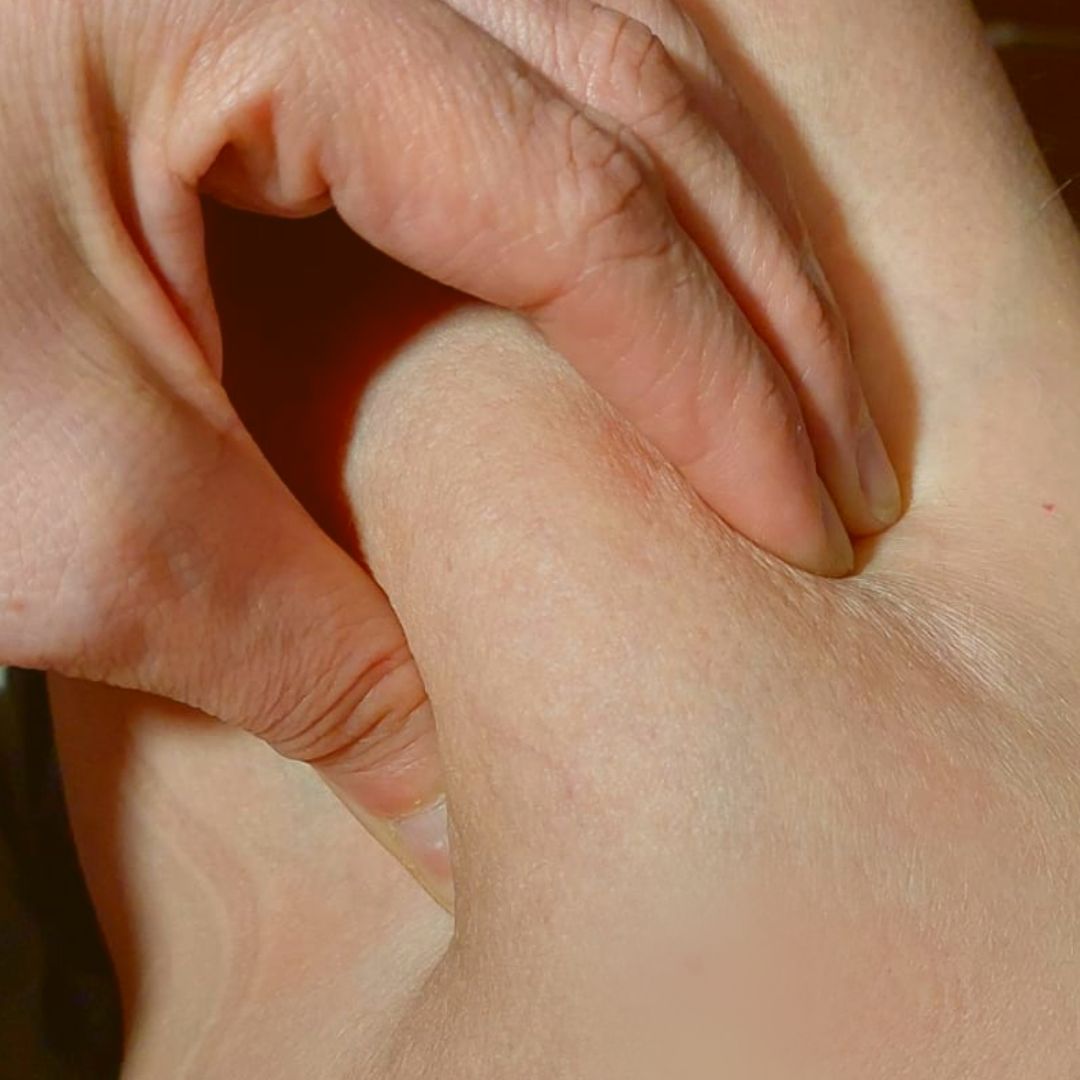
- Do you feel pain even with a light pinch? Then you very likely have lipedema. The increased and enlarged fat cells press painfully on the sensitive nerve fibers in your skin.
- Do you feel only mild pain when pinching, or at least an uncomfortable pressure sensation? This is also an indication of lipedema.
- Even if you feel no pain at all, it may still be lipedema given the corresponding appearance, since everyone develops a different pain tolerance over the years.
Nodules Under the Skin
Palpable nodules deep in the tissue, which can also be painful during the pinch test, are — based on our findings — inflammatory processes. As with psoriasis, the underlying cause in lipedema is an increased rate of cell production.
The newly formed lipedema fat cells also die off more quickly, after a shorter life cycle. The resulting inflammatory process breaks down the dead lipedema fat cells via the immune system and clears them through the lymphatic system. These inflammatory processes, and the inflammatory mediators released during them, explain the palpable, painful nodules.
To date, no sensory nerve fibers have been scientifically demonstrated within fatty tissue itself. On closer inspection, this means your lipedema fat cell cannot actually hurt on its own. Based on our observations and experience at med-plast, it is the indirect pressure of the excess fat volume on the skin’s receptors that produces and transmits the pain at the skin’s surface. That’s why the pain from the two-finger pinch test is more informative than simply pressing down on the tissue with one finger. In other words: with this one-finger pressure test, the individually perceived pressure pain in lipedema is always lower than with the two-finger pinch test.
Obesity or Lipedema — Why Do We Distinguish?
Distinguishing between lipedema and obesity isn’t easy, but it matters so we can treat you correctly. What is certain is that liposuction — surgical fat removal — is the only thing that helps with lipedema, at least to bring the condition under control long-term.
The causes of obesity can be varied — from an unhealthy lifestyle, to medication, to genetic factors.
The causes of lipedema, on the other hand, are not yet fully understood. Lipedema develops when the subcutaneous fatty tissue grows abnormally. This increase in volume affects both the number of fat cells (hyperplasia) and the size of the fat cells (hypertrophy). For both conditions, exercise and a healthy diet can help slow the progression, at least temporarily. Everyone is different and responds differently to internal and external influences. Find your own individual path!